
Trend Lines

Trendlines Are Being Broken Everywhere Today — Here’s How to Trade Them on MT5

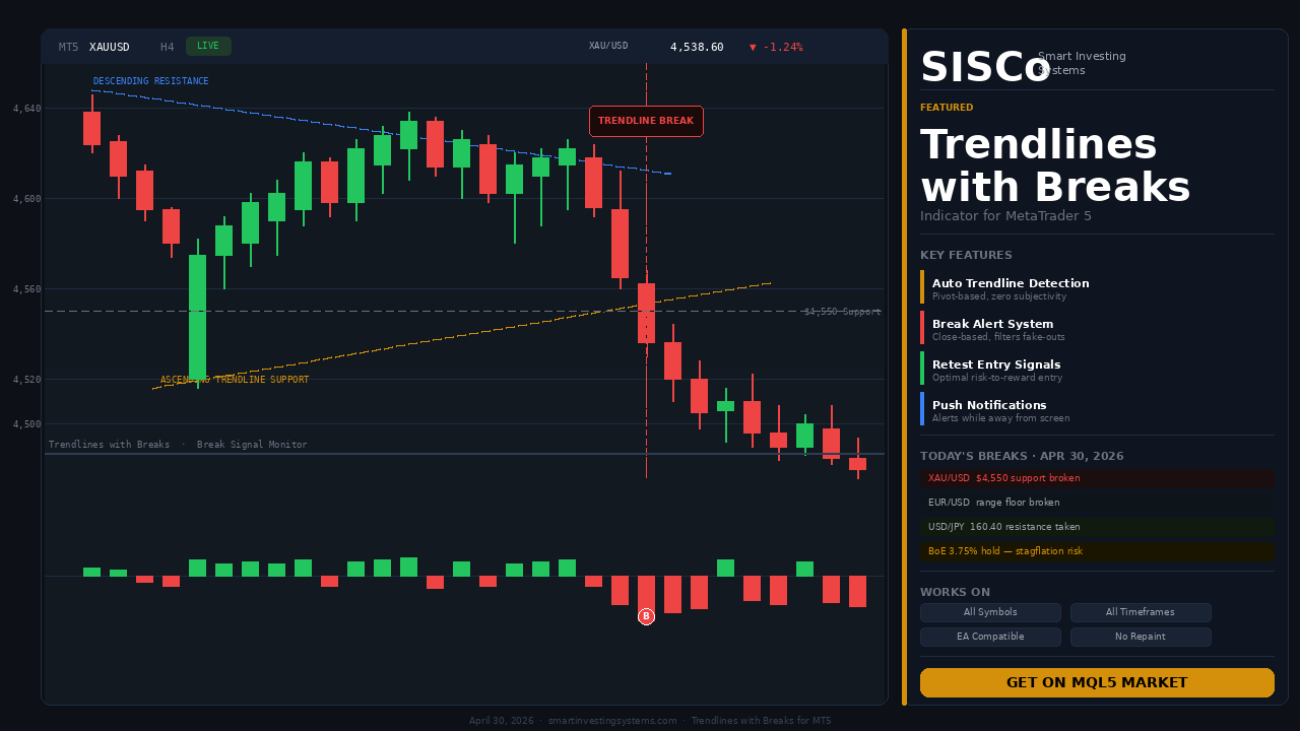
Gold broke $4,550 support today. EUR/USD is sliding as Trump pushes 15–20% minimum tariffs on EU goods. USD/JPY pushed above 160.40 with no BoJ intervention. The Bank of England held at 3.75%, the ECB held at 2%, and the market now turns entirely to Lagarde and Bailey’s tone for clues on June. In a session defined by broken levels and structural shifts, the traders navigating these moves cleanly are not reading the news — they are reading the lines.

Trendlines are the oldest tool in technical analysis. They are also one of the most inconsistently applied. The challenge has never been drawing the line — it is knowing the moment the line is no longer valid. Manual trendlines do not alert you. They do not redraw when price evolves. And they cannot tell you whether a break is genuine or a liquidity sweep designed to trap breakout traders before reversing.

The Trendlines with Breaks Indicator for MT5 solves exactly this problem. It automatically plots dynamic support and resistance trendlines directly on your chart, detects genuine structural breaks in real time, and alerts you the moment a valid break occurs — so you can act on the move rather than react to it after the fact. On a day like today, when gold just broke its first major support in three weeks and EUR/USD is carving out a new lower range, this is precisely the kind of tool that separates planned trades from reactive ones.

01Why Manual Trendlines Keep Failing You

Retail traders draw trendlines. Institutional traders break them — on purpose. Understanding this dynamic is the first step to using trendlines profitably rather than as a source of repeated losses.

When a trendline has been visible on a chart for an extended period, it attracts two types of participants: traders who buy or sell the line on touch, and traders who place stop losses just beyond the line. Market makers know exactly where both groups are positioned. The result is predictable: price sweeps through the trendline, triggers the stops, reverses, and leaves both groups trapped on the wrong side of a move they saw coming.

The solution is not to stop using trendlines — it is to automate their detection and add a confirmation filter to break signals. That is what the Trendlines with Breaks indicator delivers.

01

Automatic Detection

The indicator identifies valid swing highs and lows and connects them into trendlines automatically — removing subjectivity from line placement and ensuring you are trading the same lines the algorithm is tracking.

02

Break Detection

When price closes convincingly beyond a trendline, the indicator flags the break immediately — with a visual marker on the chart and an optional alert. No more second-guessing whether a wick counts as a break.

03

Real-Time Alerts

Popup and push notification alerts fire the moment a valid break is confirmed — so you do not need to watch the chart all session. The alert comes to you, not the other way around.

02Today’s Market Through the Lens of Trendline Breaks

April 30, 2026 is a textbook example of why trendline break detection matters more than trendline drawing. Three of the most-watched levels in global markets broke today — each with its own structural story.

Gold · $4,550 Break

XAU/USD broke its three-week ascending trendline support at $4,550, with the Forex Factory community already tracking targets of $4,515 and $4,300. Powell’s cautious tone at the FOMC triggered profit-taking that had been building for days. Traders watching the trendline manually missed the entry by 20–30 pips. A break alert would have fired at candle close.

EUR/USD · Range Lower Boundary

EUR/USD broke its short-term consolidation base as Trump’s 15–20% EU tariff announcement hit the wires. The pair’s descending trendline from 1.1820 was already drawing lower highs — a textbook descending channel. The break of the range floor confirmed the next leg lower toward 1.1660 support.

USD/JPY · 160 Resistance Break

USD/JPY pushed through the 160.00 resistance trendline with no verbal intervention from Japanese officials. The level is a well-documented intervention threshold — but without a confirmed BoJ response, the break is trending. Trendline break detection on the H1 alerted at the confirmed close above 160.40.

All three of these were trendline breaks visible to any chart reader — but only those who had automated break detection received a clean, unambiguous entry signal without having to manually monitor three separate charts through an event-dense session.

03The Anatomy of a Valid Break vs. a Fake-Out

The most important skill in trendline trading is not drawing the line — it is distinguishing a real break from a stop hunt. The Trendlines with Breaks indicator is built around candle-close confirmation, which filters the majority of intrabar spikes that catch manual traders off-guard.

📐 Valid Bullish Break
  1. Price closes a full candle body above the descending trendline
  2. Volume (or tick delta) is elevated on the break candle
  3. Price retests the broken trendline as new support on next candle
  4. Retest candle closes above the line — entry confirmation
📐 Fake-Out Pattern
  1. Wick penetrates the line but candle body closes below it
  2. Break occurs on low volume or narrow-range candle
  3. Price immediately returns inside the trendline channel
  4. No retest — price just drifts back without momentum

The indicator’s close-based break detection eliminates the majority of fake-out signals by design. A wick through a trendline does not trigger an alert — only a confirmed candle close beyond the line does. This single filter dramatically improves the quality of break signals across all timeframes and pairs.

04Configuration: Getting the Most from Trendlines with Breaks

The indicator gives you control over the parameters that define how trendlines are drawn and when breaks are confirmed. Here is what each setting does in practice.

ParameterWhat It ControlsRecommended Starting Point
Pivot LookbackHow many candles either side of a swing point the indicator uses to validate a high or low as a pivot. Higher values = fewer but stronger trendlines.5–10 for swing trading; 3–5 for intraday
Trendline LengthMinimum number of candles a trendline must span to be considered valid. Prevents very short-term noise lines from generating signals.15+ candles for H1 and above
Break ConfirmationWhether the break is confirmed on candle close or on intrabar penetration. Close-based is strongly recommended to avoid fake-out entries.Always use candle close
Alert ModePopup only, push notification only, or both. Push notifications allow you to trade break signals away from the screen.Both — popup + push
Line StyleSolid, dashed, or dotted. Visual preference, but dashed lines are easier to read when multiple trendlines are active simultaneously.Dashed for active lines, solid for broken

05A Five-Step Framework for Trading Trendline Breaks

01

Let the indicator establish the trendline

Do not draw your own lines on top of the indicator’s. Trust the automated pivot detection. If you see a line you disagree with, adjust the pivot lookback parameter rather than overriding it manually — otherwise you introduce the same subjectivity the tool is designed to remove.

02

Note the break alert — but do not enter immediately

When the break alert fires, mark the candle that closed beyond the trendline. This is your signal candle, not your entry candle. Entering on the break candle itself exposes you to the retracement that almost always follows the initial break move.

03

Wait for the retest of the broken trendline

After a genuine break, price almost always returns to test the broken line from the other side — as new resistance (for bearish breaks) or new support (for bullish breaks). This retest is your entry point. It gives you a tighter stop loss and a better risk-to-reward ratio than the initial break candle entry.

04

Confirm with structure and context

Check that the break aligns with the higher timeframe trend and with a key structural level. Today’s gold break at $4,550 was valid partly because it aligned with the H4 chart’s descending structure from the $4,890 high. A trendline break that cuts across the higher timeframe trend has much lower follow-through probability.

05

Manage stop loss relative to the broken trendline

Place your stop loss on the other side of the broken trendline — not beyond the signal candle’s high or low. If the trendline was the key level, price returning to the wrong side of it invalidates the trade thesis. Keeping your stop tight to the line rather than the candle dramatically improves your average risk-to-reward across all break trades.

06Common Mistakes When Trading Trendline Breaks

⚠️

Entering on the break candle instead of the retest. The break candle often represents the maximum momentum of the move. Entering there gives you the worst possible entry price, the widest stop loss placement, and the lowest risk-to-reward of the entire trade setup. Patience for the retest is the single biggest improvement most trendline traders can make.

🔍

Trading trendline breaks in isolation from higher timeframe context. A break on the M15 that goes against the H4 trend is a counter-trend trade dressed up as a breakout. Always confirm that the break direction is aligned with the higher timeframe structure before committing to a position.

📅

Ignoring the economic calendar. Today’s BoE, ECB, and FOMC decisions created artificial trendline breaks — moves driven entirely by news flow rather than structural supply and demand. During major event windows, trendline breaks have higher fake-out rates. The indicator fires the alert; it is your job to check whether a high-impact event just occurred.

📐

Treating every trendline as equal. A trendline connecting two pivot points has far less significance than one connecting five or six. The more times a trendline has been tested and held, the more meaningful its eventual break. Configure the minimum pivot count to ensure the indicator only highlights high-significance lines.

07Why Today’s Session Makes This the Right Tool Right Now

With the ECB holding at 2% and Lagarde taking centre stage, and the BoE holding at 3.75% while Bailey acknowledges the stagflation risk from Hormuz energy disruptions, the market is in a regime where levels matter more than momentum. Central banks are on hold. The narrative is unclear. Inflation expectations are rising while growth risks are increasing simultaneously.

In this environment, the market respects trendlines more aggressively than in trending regimes — because institutional players use them as reference points to position ahead of anticipated policy shifts. When EUR/USD tests its descending trendline from 1.1820 and fails, that failure is meaningful. When gold’s ascending trendline from its March lows breaks at $4,550, that break is a structural signal — not noise.

📐
Automated trendline detection removes subjectivity from line placement
🔔
Close-based break alerts filter fake-outs caused by wicks and stop hunts
🎯
Retest entry after the alert maximises risk-to-reward on every break trade
📱
Push notifications mean you never miss a break on any watched pair
🌍
Works on all symbols and timeframes — one tool, entire watchlist

Never Miss a Trendline Break Again

The Trendlines with Breaks Indicator for MT5 automatically draws, tracks, and alerts you on every valid trendline break — across all pairs and timeframes, with push notification support so the market comes to you.

Conclusion

Today’s session — gold breaking $4,550, EUR/USD losing its footing on EU tariff fears, USD/JPY pressing above 160 — was a masterclass in structural trendline breaks. Each of these moves was telegraphed by the trendline structure before the news hit. The traders who were positioned correctly were not the ones with the fastest news feed. They were the ones watching the lines.

📈
Trendlines identify structure — breaks identify opportunity
🔔
Automated alerts mean you act on the break, not after it
⏱️
Retest entry + structure alignment = your highest-quality setups
🛡️
Stop loss on the broken line = tight risk, clean invalidation

The market will keep breaking levels. The BoE and ECB tone on June, the next FOMC, the Hormuz situation, the EU tariff negotiations — all of these will produce new trendline breaks across gold, forex, and indices in the sessions ahead. Have the tool that tells you when they happen.
Disclaimer: This article is for educational and informational purposes only. It does not constitute financial or investment advice. Trading forex and financial instruments carries significant risk. Past performance of any indicator does not guarantee future results. Always practise proper risk management.
CDV

What Is Cumulative Delta Volume — and Why Price Alone Isn’t Enough

With the Federal Reserve meeting tomorrow — Jerome Powell’s final session as FOMC Chair — and the Bank of Japan delivering its rate decision today, this week is the most event-dense week of 2026 for forex traders. In markets this volatile, the traders who survive are not the ones with the best indicators. They are the ones who understand who is actually in control of price. That is exactly what the Cumulative Delta Volume indicator is built to show you.

Volume tells you how much trading activity occurred on a candle. Cumulative Delta Volume tells you which side of the market controlled that activity. It is one of the most underused concepts in retail forex trading — and in a week where gold has slipped to one-month lows near $4,590, EUR/USD is testing the 1.1710 level with six central bank decisions in four days, the ability to read order flow rather than just price is no longer optional. It is a genuine edge.

The Cumulative Delta Volume (CDV) Indicator for MT5 quantifies the difference between buying and selling volume on each candle and accumulates that difference over time — giving you a real-time view of institutional order flow that most retail traders never see. This article explains exactly how to use it, and why this week in particular is the right time to add it to your workflow.

01What Is Cumulative Delta Volume — and Why Price Alone Isn’t Enough

Every candlestick on your chart tells you four things: the open, high, low, and close. What it does not tell you is whether the buying volume or the selling volume was dominant during that candle’s formation. Two candles can look identical in terms of price range and close — but one may have been driven by aggressive buyers lifting the ask, while the other was driven by sellers hitting the bid. That distinction changes everything about how you should interpret the move.

Delta volume is the difference between buying volume (transactions that occurred at the ask) and selling volume (transactions that occurred at the bid) within a single candle. A positive delta means buyers were more aggressive. A negative delta means sellers were more aggressive.

Cumulative delta accumulates these values over time — building a running total that shows you when institutional order flow is genuinely aligned with price direction, and — critically — when it is not.

01

Delta Divergence

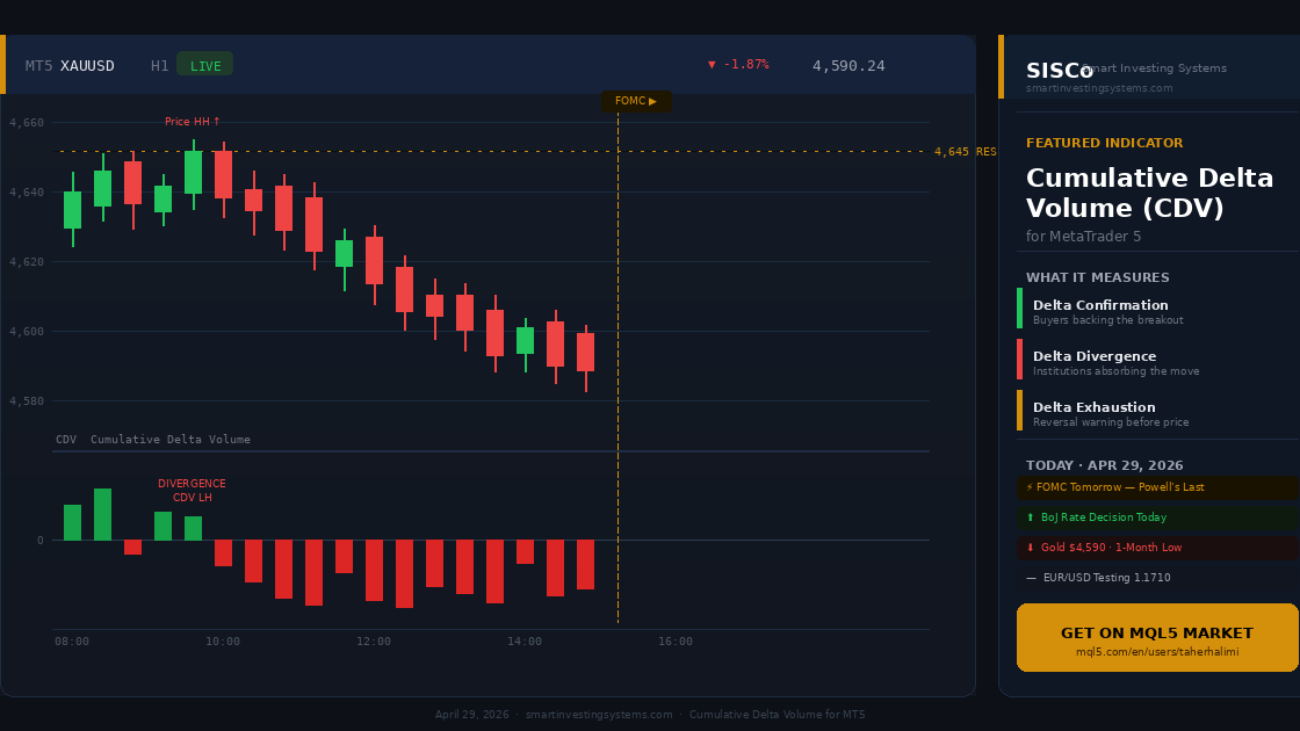
Price makes a new high but CDV fails to confirm with a new peak. Institutional sellers are absorbing the move — a reversal warning most price-only traders miss entirely.

02

Delta Confirmation

Price breakout is accompanied by a surge in positive cumulative delta. Buyers are genuinely in control. This is the confirmation that separates real breakouts from fakeouts.

03

Delta Exhaustion

Cumulative delta makes an extreme reading in one direction while price consolidates. Aggressive one-sided order flow is meeting supply or demand — often the last signal before a sharp reversal.

02The Three Market States CDV Identifies

Before applying the indicator, you need to understand what it is actually measuring in each market condition. CDV reads very differently depending on whether the market is trending, reversing, or distributing.

Trending Bullish

Price makes higher highs and CDV rises in parallel. Buying pressure is genuine and increasing. Trend continuation setups are valid — pullbacks to rising CDV are high-probability entries.

Trending Bearish

Price makes lower lows and CDV drops in parallel. Selling pressure is dominant. Any rally that fails to push CDV back into positive territory is a potential continuation short.

Divergence / Distribution

Price and CDV disagree. This is the most important condition — it signals that the side driving price does not have genuine order flow support. Reversals and traps are most common here.

This week, with gold slipping from its $4,645 highs to $4,590 despite ongoing Strait of Hormuz tensions, CDV divergence has been precisely the signal that preceded the selloff — price was holding while cumulative selling delta was quietly building. Traders watching only candlesticks saw strength. Traders watching delta saw distribution.

03Reading CDV Signals: Bullish vs. Bearish Setups

The practical application of CDV comes down to recognising two primary signal types — confirmation and divergence — across both directional biases.

📈 Bullish CDV Signals
  1. Price breakout above resistance + CDV surging positive
  2. Pullback to support with CDV holding above zero line
  3. CDV makes new high before price does — leading indicator
  4. Seller exhaustion: CDV spikes negative then reverses sharply
📉 Bearish CDV Signals
  1. Price at resistance + CDV turning negative on the approach
  2. Price new high but CDV makes a lower high — classic divergence
  3. Rally on declining CDV — buyers aren’t backing the move
  4. Buyer exhaustion: CDV spikes positive then collapses

The divergence signal is the one that generates the most consistent high-probability trades. When EUR/USD was grinding toward 1.1820 last week, cumulative delta on the H1 chart was already declining — the buying pressure that had lifted price from 1.1600 was quietly being absorbed. That divergence resolved with the retracement back to 1.1710 support that the market is currently navigating.

04CDV Parameters — What to Configure and Why

The CDV Indicator for MT5 gives you control over the key variables. Knowing what each parameter actually does determines whether the tool gives you useful signal or noise.

Parameter Effect Recommended Setting
Reset PeriodHow often the cumulative total resets to zero. Session-based resets show intraday order flow; no reset shows longer-term accumulation.Session reset for intraday; none for swing
Volume TypeTick volume (available on all brokers) vs real volume (requires ECN broker data). Tick volume is a reliable proxy for most forex pairs.Tick volume for forex pairs
Color SensitivityThe threshold at which delta is considered significantly positive or negative. Too tight = noise; too wide = late signals.Calibrate to average candle volume on your pair
Histogram SmoothingApplies a moving average to the delta bars, reducing noise at the cost of some lag.Off for scalping; 3-period MA for swing

05A Step-by-Step Framework: Trading This Week’s Events with CDV

With the FOMC decision tomorrow, BoE and ECB on Thursday, and US GDP + Core PCE data also releasing, this is the highest-impact week of the quarter for forex volatility. Here is exactly how to use CDV around high-impact events.

01

Establish the pre-event CDV baseline

In the two to four hours before a major release (FOMC, GDP, CPI), note the CDV trend. Is it rising, falling, or flat? This tells you where institutional positioning is before the event — not where the market will go, but where smart money was leaning into the news.

02

Watch the spike candle’s delta, not just its close

When the news drops, price moves sharply. Most traders react to the candle close. CDV traders watch whether the spike candle carries a delta consistent with the direction — or whether it is a thin, low-volume move that the market is likely to fade. A large news candle with near-zero or opposing delta is a fade candidate.

03

Wait for the post-spike retest and CDV confirmation

After the initial move, price almost always retests the breakout level. This is your entry window. If CDV is rising on the retest (for a long) or falling (for a short), order flow is confirming the new direction. This is the highest-probability entry in event-driven trading.

04

Use CDV to manage the trade, not just the entry

Once in a trade, monitor CDV on a lower timeframe. If price is holding its level but CDV is drifting against you, reduce position size or tighten your stop — the order flow signal is warning that the move may be losing genuine momentum before price confirms it.

05

Exit on delta exhaustion, not just price targets

The cleanest exits come when CDV makes an extreme reading and then reverses — even if price has not yet reached your target. Delta exhaustion often precedes price reversal by one to three candles, giving you time to exit at a more favourable level than a standard price-based target would allow.

06Common CDV Mistakes to Avoid

⚠️

Treating every delta divergence as an immediate reversal signal. Divergence can persist for many candles in a strongly trending market. Divergence is a warning that momentum is weakening — not a standalone entry trigger. Always combine it with a structural signal: a failed swing high, a CHOCH, or a key level being tested.

📊

Using CDV without a defined reset period. If cumulative delta is never reset, the line drifts further from zero indefinitely and loses interpretive value. Define whether you are measuring session delta, daily delta, or rolling delta — and stick to one context per chart setup.

🕐

Applying CDV on timeframes below M5 in volatile sessions. During high-impact news releases, tick volume spikes create delta readings that are too noisy to interpret meaningfully on M1. Drop to M5 as your minimum during event windows — the signal clears considerably.

💱

Ignoring pair-specific volume behaviour. EUR/USD and GBP/USD carry far higher tick volume than exotic pairs. A “large” delta reading on EUR/USD would be an extreme outlier on USD/ZAR. Calibrate your sensitivity thresholds per pair, not globally across your watchlist.

07Why CDV Belongs in Your Toolkit This Week

This is not a normal trading week. Between today’s Bank of Japan decision — with USD/JPY sitting just below the critical ¥160 level where intervention risk is highest — and tomorrow’s FOMC (the last meeting chaired by Jerome Powell before Kevin Warsh takes over), the market is priced for movement in every major pair simultaneously.

In environments like this, price action alone becomes unreliable. False breakouts multiply. Liquidity sweeps are engineered before the real move begins. The traders positioned on the wrong side of a news spike are almost always those who reacted to price without understanding the order flow underneath it.

CDV provides the layer of context that price cannot. It shows you, in real time, whether the institutions moving markets are genuinely committing capital to a direction — or whether a move is thin and likely to reverse. That information, applied consistently through a structured framework like the one above, is what separates reactive trading from informed decision-making.

🌊
CDV rising alongside price = genuine trend — look for continuation entries on pullbacks
CDV diverging from price = distribution or accumulation — prepare for reversal, wait for structural confirmation
🎯
Post-news retest + CDV confirmation = highest-probability event trade entry
🛡️
CDV exhaustion reading = exit signal — often leads price by 1–3 candles
📐
Always combine with a structural level — CDV alone is context, not a trigger

See Exactly Who Is Driving Price — In Real Time

The CDV Indicator for MT5 displays cumulative buying and selling delta directly on your chart, with configurable reset periods, color-coded histogram, and full EA compatibility. Built for traders who want to trade order flow, not just price.

Conclusion

Every price move has a volume story behind it. Cumulative Delta Volume is the tool that reads that story in real time — separating genuine institutional commitment from retail-driven noise that evaporates the moment a key level is tested.

📈
CDV rising alongside price confirms the trend is real
🔍
CDV diverging from price warns before price confirms
Post-event retest + CDV alignment defines your entry
🏁
Delta exhaustion tells you when to exit — before the crowd does

In a week featuring the FOMC, BoJ, BoE, ECB, US GDP, and Core PCE all within four trading days, the markets will move. CDV does not tell you which direction they will move — but it tells you, with real data, whether that direction has genuine institutional backing behind it. That is the difference between guessing and trading with an edge.

Disclaimer: This article is for educational and informational purposes only. It does not constitute financial or investment advice. Trading forex and financial instruments carries significant risk. Past performance of any indicator does not guarantee future results. Always practise proper risk management.


waddah_attar

Why Your Breakouts Keep Failing — And How the Waddah Attar Explosion Fixes It

You have seen it happen. Price breaks cleanly above resistance. You enter long. The candle closes. Then price immediately reverses and hunts your stop loss. This is not bad luck — it is a systemic problem with trading price alone. The Waddah Attar Explosion exists to fix it.

This is one of the most common and costly patterns in retail trading — and it happens because most breakout strategies have a fatal flaw: they rely on price alone, with no way to measure whether real momentum is behind the move.

A price breakout without momentum is just a trap. And in 2026, with algorithmic players actively engineering stop runs around key levels, trading breakouts blindly is more dangerous than ever.

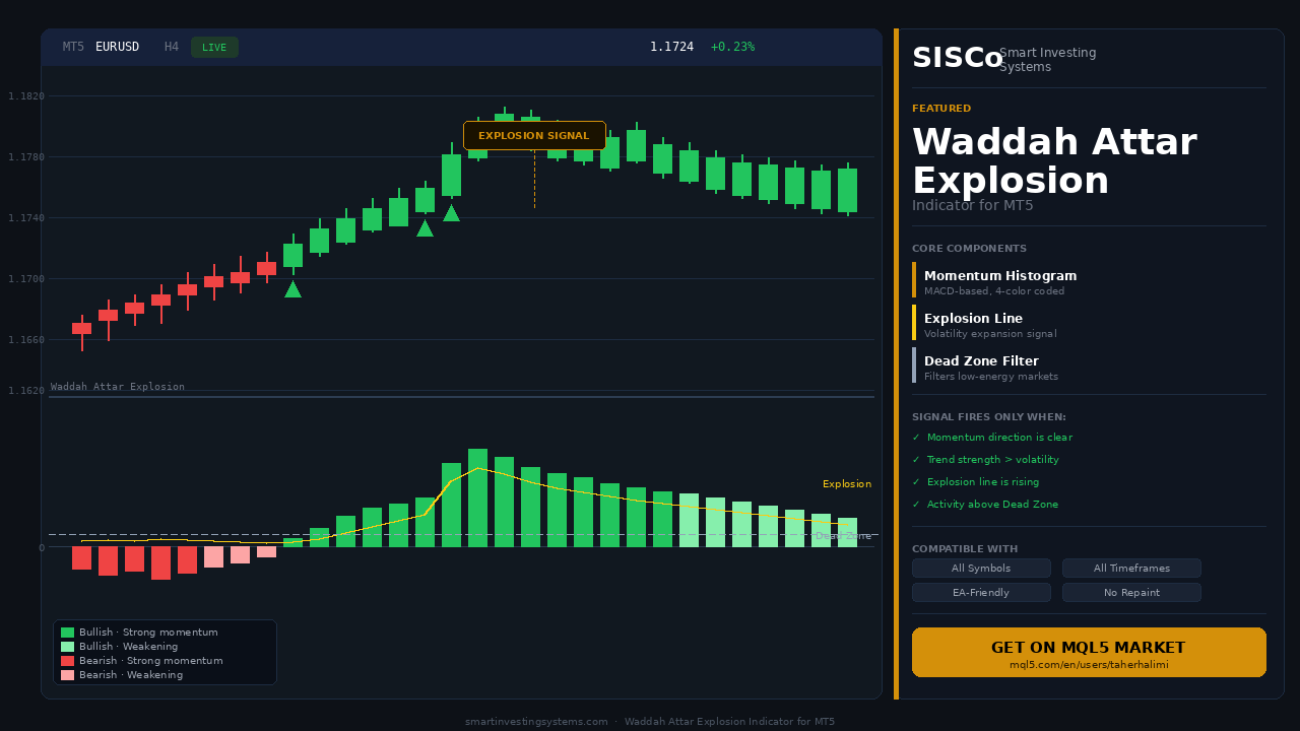
The Waddah Attar Explosion indicator for MetaTrader 5 was built specifically to address this problem. It does not just show you that price moved — it shows you whether there was genuine energy behind the move, and filters out the low-activity noise that causes false entries.

01What Is the Waddah Attar Explosion?

The Waddah Attar Explosion (WAE) is a momentum and volatility-based indicator that combines three distinct calculations into a single, clean display in a separate chart window:

01

Trend Momentum

MACD-style EMA acceleration measuring whether momentum is genuinely building in a direction.

02

Volatility Expansion

Standard deviation (Bollinger-style) confirming whether price is expanding out of its recent range.

03

Dead Zone Filter

Dynamic floor from the average true range that filters out all signals when market activity is too low to trade.

When all three align — momentum is directional, volatility is expanding, and activity is above the dead zone — the indicator fires. When they do not, it stays quiet. This multi-condition design is what separates the WAE from simple momentum oscillators that signal constantly regardless of market conditions.

02Understanding the Visual Elements

Waddah Attar Explosion histogram, explosion line, and dead zone on MT5 chart

The WAE indicator in a separate sub-window — histogram, Explosion Line, Dead Zone, and signal arrows

The indicator displays in a sub-window below your main chart with four key visual elements:

Bright green — bullish momentum increasing
Fading green — bullish momentum weakening
Bright red — bearish momentum increasing
Fading red — bearish momentum weakening

⚡ Explosion Line

The volatility expansion threshold. A signal only has meaning when the histogram clears above this line. Below it = low-energy move, avoid it.

🚫 Dead Zone Line

The low-activity filter. Any reading below this line should be ignored. The market is saying there is not enough participation here to trade.

🟢 Buy Arrows

Appear on the main chart only when all conditions are simultaneously met — momentum, volatility, and activity aligned.

🔴 Sell Arrows

Same logic, bearish direction. The arrow only fires when the histogram clears both the Explosion Line and the Dead Zone.

03The Dead Zone: The Feature Most Traders Overlook

Most momentum indicators generate signals every few bars. This sounds useful until you realize that most of those signals appear during low-volume, sideways markets — exactly when you should not be trading.

The Dead Zone filter changes this entirely. Think of it as an energy threshold. If the market is not generating enough volatility to clear the Dead Zone line, the indicator produces no arrows. You do not have to decide whether to take a signal — the indicator has already made that decision for you.

This is particularly valuable during:

Asian Session

Forex markets are notoriously quiet and prone to false, low-conviction moves that reverse sharply at London open.

Pre-News Consolidation

Price compresses before a major economic release. The Dead Zone keeps you out until the real move develops.

Weekend Gap Fills

Early Monday price action can be disorderly. Low activity stays below the Dead Zone, protecting you automatically.

04Buy, Sell & Exit Signal Logic

Waddah Attar Explosion buy and sell signal examples on MT5

Buy and sell arrows fire only when all four conditions are simultaneously confirmed

Signals are generated only when all four conditions are met at the same time:

✅ Buy Signal
  1. 1Green histogram bar is rising (bullish momentum building)
  2. 2Green histogram is above the Explosion Line
  3. 3The Explosion Line itself is rising (volatility expanding)
  4. 4Both readings are above the Dead Zone
✅ Sell Signal
  1. 1Red histogram bar is rising (bearish momentum building)
  2. 2Red histogram is above the Explosion Line
  3. 3The Explosion Line itself is rising
  4. 4Both readings are above the Dead Zone
❌ Exit Signal
  1. The histogram (green or red) starts declining and crosses back below the Explosion Line — momentum is exhausting, close the trade.

This last point matters: the WAE does not just help you enter — it also gives you a clear, objective exit trigger. When the histogram fades back below the Explosion Line, the energy is gone. That is your signal to close.

05Practical Strategy: WAE With Trend Context

The Waddah Attar Explosion works best when combined with a higher timeframe trend filter. Here is a clean, repeatable approach:

01

Identify the higher timeframe trend

Use a 4H or Daily chart and determine the dominant direction. Higher highs and higher lows = uptrend. Lower highs and lower lows = downtrend.

02

Drop to your entry timeframe

Switch to a 1H or 15M chart where you will watch for WAE signals aligned with the higher timeframe direction.

03

Wait for WAE alignment

Take only buy signals when the higher timeframe trend is bullish. Take only sell signals when bearish. This single filter ensures you trade with institutional flow, not against it.

04

Confirm at a key level

The highest-probability setups occur when a WAE signal fires at or near a significant support (for buys) or resistance (for sells), adding structural confluence.

05

Manage the trade objectively

Hold as long as the histogram stays above the Explosion Line. When it crosses back below, close. Simple. Objective. Repeatable.

06The Built-In Signal Tester

Waddah Attar Explosion built-in signal tester showing win rate on MT5 chart

The on-chart tester displays total trades, wins, and win rate — no separate backtesting software required

One feature that sets this indicator apart from most commercial tools is the on-chart signal tester — built directly into the indicator with zero extra setup.

Define a take-profit level, a stop-loss level, and a start date. The tester then simulates every historical buy and sell signal over that period and displays on your chart: total trades simulated, number of winning trades, and the win rate percentage.

This is not backtesting software — it is a fast, visual way to evaluate how the indicator performs on your specific symbol and timeframe, without opening a strategy tester or writing any code. Use it to calibrate the sensitivity settings before going live.

07Customization: Adapting to Your Market

Waddah Attar Explosion customization settings panel in MT5

Full parameter control lets you tune the indicator to each symbol and timeframe

Every market behaves differently. Gold has different volatility characteristics than EUR/USD. Crude oil trades differently than GBP/JPY. The WAE includes full parameter control:

Parameter What It Controls
SensitivityHow strongly momentum acceleration is amplified — higher = faster reaction
Fast EMA LengthSpeed of the fast exponential moving average
Slow EMA LengthSpeed of the slow exponential moving average
Channel LengthPeriod for the volatility (Bollinger) calculation
BB MultiplierWidth of the volatility envelope — higher = fewer, stronger signals
Chart ThemeLight or dark background compatibility

A higher Sensitivity setting makes the indicator react faster — useful on 15M or 1H timeframes. Lower Sensitivity on 4H or Daily produces smoother, less frequent, but higher-conviction signals. Start with defaults, run the built-in tester over 3–6 months, then adjust.

08What This Indicator Does Not Do

Honesty matters. The Waddah Attar Explosion is a powerful tool, but it has limits worth understanding before you trade with it:

🔮

It does not predict the future. No indicator does. It measures current momentum and volatility conditions, not what happens next.

📉

It can produce losing signals. Even with all four conditions met, the market can reverse. No signal filter eliminates all losses.

📊

It works better in trending conditions. Like all momentum tools, it is less reliable in prolonged sideways or range-bound markets.

🧩

It should not be used in isolation. It was designed to work within a broader strategy that includes higher timeframe context, key levels, and proper risk management.

Think of the WAE as a high-quality gatekeeper — it dramatically improves the quality of your entries, but it does not replace a complete trading plan.

09Technical Specifications

Waddah Attar Explosion indicator results on live MT5 chart

The WAE running on a live MT5 chart — compatible with all symbols and timeframes

PlatformMetaTrader 5
TypeMomentum + Volatility
TimeframesAll (M1 to Monthly)
MarketsForex, Gold, Indices, Crypto
Trading StyleScalping, Day, Swing
EA CompatibleYes — buffer-based, no repaint
AlertsPopup + Push Notifications
Signal TesterBuilt-in, on-chart

Get the Indicator

The Waddah Attar Explosion for MT5 is available now on the MQL5 Market. Stop filtering entries by eye — let momentum and volatility do it for you.

Conclusion

Fake breakouts are not going away. In fact, as algorithmic liquidity hunting becomes more sophisticated in 2026, low-quality breakout signals are becoming more common, not less.

The Waddah Attar Explosion does not make you a perfect trader — nothing does. But it gives you something invaluable: a clear, objective filter that tells you when momentum and volatility are genuinely aligned, and when they are not.

Stop entering on price alone. Start asking whether the energy is there to back it up.

Disclaimer: This article is for educational and informational purposes only. It does not constitute financial or investment advice. Trading forex and financial instruments carries significant risk. Past performance of any indicator does not guarantee future results. Always practice proper risk management.
CHOCH BOS

Why Your CHOCH Signals Keep Failing—And How to Fix That

CHOCH BOS
You added a market structure indicator to your chart. A CHOCH label appeared. You entered expecting a reversal. The trade stopped out. Price continued as if nothing happened. This is not bad luck — and this article explains exactly why it keeps happening, and the specific sequence that fixes it.

This is one of the most common frustrations among traders who have recently discovered Smart Money Concepts and CHOCH/BOS analysis. The signals look clean in hindsight. They are far messier in real time.

The problem is rarely the concept itself. CHOCH and BOS are grounded in one of the oldest and most tested frameworks in technical analysis — the study of successive highs and lows first formalized by Charles Dow in the early 1900s and later expanded by Richard Wyckoff. The problem is how most traders interpret and act on these signals without understanding what they actually confirm, and what they do not.

By the end of this article you will have a clear rule set for when to act on a CHOCH signal, when to wait, and why the distinction matters.

01The Foundation: What Market Structure Actually Measures

Before CHOCH and BOS can make sense, you need a clear picture of what market structure is — because the terms are used loosely in most online content, and that looseness is where the confusion begins.

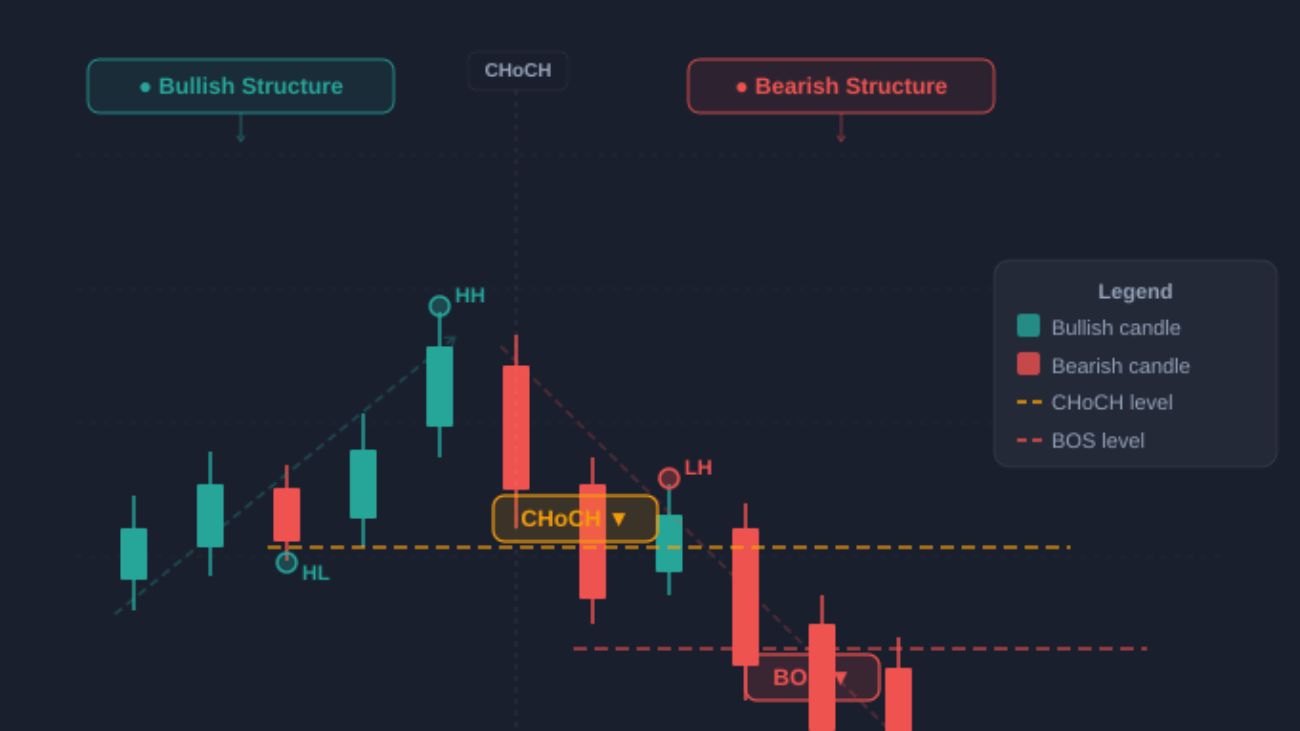
Market structure is the sequential relationship between swing highs and swing lows. Every chart is essentially a record of these sequences. Charles Dow observed that markets move in waves — advances and declines, each composed of smaller advances and declines. The direction of those waves, and whether each new wave exceeds or fails to match the previous one, tells you who is in control.

Three structural states exist:

Bullish Structure

Price prints a sequence of higher highs (HH) and higher lows (HL). Each rally exceeds the previous peak. Each pullback holds above the previous trough. Buyers are dominant.

Bearish Structure

Price prints a sequence of lower lows (LL) and lower highs (LH). Each decline exceeds the previous trough. Each bounce fails to reach the previous peak. Sellers are dominant.

Ranging Structure

Price oscillates between a defined ceiling and floor without directional progress. Neither buyers nor sellers have control.

What the Smart Money Concepts community contributed — through educators like ICT (Michael Huddleston) — was a more granular labeling system: specifically, the distinction between a break of structure and a change of character.

02Break of Structure (BOS): The Trend Is Still Alive

A break of structure is the simpler of the two signals, and the one that carries less risk when acted upon. A BOS occurs when price breaks a swing point in the direction of the existing trend.

📈 Bullish BOS
  1. Price breaks above a previous higher high
  2. The uptrend is continuing
  3. Buyers pushed to a new peak
  4. Trend continuation signal — not a reversal
📉 Bearish BOS
  1. Price breaks below a previous lower low
  2. The downtrend is continuing
  3. Sellers extended the decline
  4. Trend continuation signal — not a reversal

What a BOS tells you: Nothing has changed. The existing trend remains valid. Its primary use is to confirm your higher timeframe bias is still intact, identify where trend-aligned pullback entries may develop, and avoid premature exits from profitable positions. A BOS is the market saying: “The dominant side just pressed their advantage.”

03Change of Character (CHOCH): Something Has Shifted — But What?

A change of character is a break of structure against the existing trend.

Signal Context Level Broken Interpretation
BOS (bullish)UptrendPrevious higher highTrend continuing up
BOS (bearish)DowntrendPrevious lower lowTrend continuing down
CHOCH (bull→bear)UptrendPrevious higher lowPotential reversal down
CHOCH (bear→bull)DowntrendPrevious lower highPotential reversal up

Here is the sentence that most traders never read carefully enough:

A CHOCH is a warning, not a confirmation. It tells you that the existing structure has been violated once. It does not tell you that a new trend has begun. This distinction is the entire source of the problem.

04Why CHOCH Fails: The Liquidity Trap

Understanding why CHOCH signals fail is more valuable than understanding when they work — because it forces you to apply an additional filter before every entry.

Large participants — banks, hedge funds, and market makers — require substantial liquidity to fill their positions. That liquidity exists at predictable locations: just below swing lows where retail stop losses are clustered, and just above swing highs where breakout orders accumulate.

A common institutional pattern is to engineer a short-term move that breaks a structural level, triggering retail stops and breakout entries, then reverse sharply once that liquidity has been consumed. This engineered move produces a CHOCH signal on the chart — but it is not a genuine reversal. It is a liquidity sweep followed by a continuation of the original trend.

This is why a CHOCH without a subsequent confirming signal has a poor track record as a standalone entry trigger. The chart appears to signal a reversal. It is actually a trap. The key filter is what comes after the CHOCH.

05The CHOCH-to-BOS Sequence: The Only Entry Worth Taking

Never act on a CHOCH signal alone. Wait for a confirming BOS in the new direction.

After a genuine CHOCH, the following sequence should develop if the reversal is real:

01

CHOCH forms

Price breaks the structural level against the existing trend. This is the warning — not the entry.

02

Retracement follows

A bounce develops but fails to reach the previous extreme — forming a lower high (if reversing from bullish) or a higher low (if reversing from bearish).

03

BOS in the new direction confirms

The market breaks the CHOCH swing low (or high), producing a BOS in the new direction. Only now is a new structural sequence confirmed.

04

New trend structure begins

The first LH + LL (or HL + HH) of the new trend is now in place. This is the closest thing to objective reversal confirmation that pure price action offers.

This CHOCH-to-BOS sequence transforms a warning signal into a confirmation. It requires the market to form two structural data points in the new direction before you commit capital.

06A Step-by-Step Trading Framework for MT5

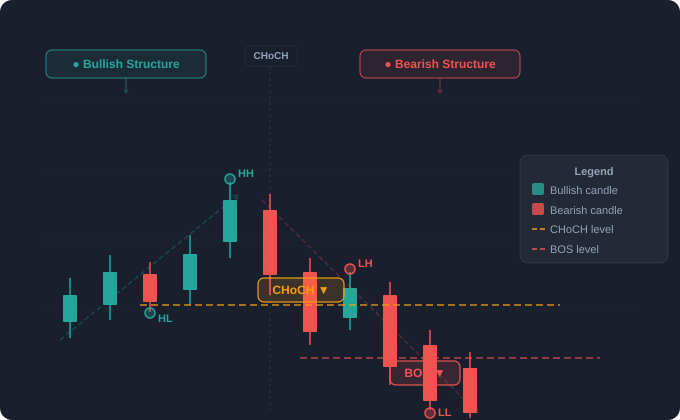
CHOCH BOS market structure diagram on MT5 chart

CHOCH and BOS signals labeled on a live MT5 chart — the sequence matters more than the individual signal

01

Establish higher timeframe bias

Begin on the Daily or H4 chart. Identify the current structural state: bullish (HH/HL), bearish (LL/LH), or ranging. This is your directional filter — you will only look for reversal setups that align with a potential shift in this structure.

02

Identify a CHOCH on a lower timeframe

Move to H1 or M15. Look for a CHOCH forming against the current minor trend, but in the direction your higher timeframe bias suggests a reversal may be developing. A CHOCH that conflicts with the higher timeframe structure is far less significant.

03

Wait for the confirming BOS

This is the most important step — and the one most traders skip. After the CHOCH, do not enter. Watch for the market to form a lower high (or higher low) and then produce a BOS that confirms the new structural direction.

04

Enter at a Point of Interest on the retest

After the confirming BOS, price frequently retraces to test the broken level — now functioning as resistance or support. This retest, often coinciding with an order block or fair value gap, is your entry zone. Entering here significantly improves your risk-to-reward ratio.

05

Manage the trade with structure

Your stop loss belongs beyond the structural invalidation point — above the CHOCH high if short, below the CHOCH low if long. Target the next significant structural level. Do not move your stop into profit until a new BOS in your direction confirms the new trend is developing.

07The One Mistake That Makes CHOCH Strategies Unprofitable

Of all the errors traders make with this framework, one is responsible for the majority of losing trades: trading CHOCH signals on a timeframe that conflicts with the dominant structure on a higher timeframe.

A CHOCH on M15 within a strong daily uptrend is not a reversal signal. It is a pullback. What looks like a reversal on M15 is simply a retracement to the next demand zone before the higher timeframe trend resumes.

The fix is simple but requires discipline: always check one timeframe above your signal timeframe before acting. If the higher timeframe is printing a healthy BOS sequence in one direction, a counter-trend CHOCH on the lower timeframe is noise. Trade with the higher timeframe structure, not against it, until the higher timeframe itself produces a CHOCH.

08Common Errors at a Glance

⚠️

Acting on the CHOCH candle close. The candle that produces the CHOCH has not yet confirmed anything except one broken level. Wait for the full sequence to develop before committing capital.

⚙️

Using a swing detection period that is too small. If your indicator’s sensitivity is set too low, every small pullback generates a CHOCH signal. Increase the fractal period until only meaningful structural levels are detected.

📏

Ignoring the quality of the CHOCH. A break that barely clears the structural level by a few pips and immediately closes back above it is far less significant than one with a strong close and clear momentum. The strength of the break matters.

💧

Forgetting liquidity context. If the CHOCH break occurs directly into a large pool of liquidity — a previous high or low where many stops are resting — the probability that the move is a sweep rather than a reversal is elevated. Be more cautious in these zones.

09What to Look for in a Market Structure Indicator

Manually identifying every swing high and low across multiple timeframes is time-consuming and prone to human error, particularly in fast-moving sessions. If you choose to use a dedicated market structure indicator, there are several qualities worth evaluating before relying on any tool.

🎛️
Configurable swing sensitivity. A fixed fractal period suits some markets but produces noise in others. An indicator that lets you adjust the swing detection period gives you control over which structural levels are considered significant.
🎨
Clear visual distinction between CHOCH and BOS. The two signals mean very different things. An indicator that colors them identically or labels them ambiguously defeats the purpose — each signal type should be immediately distinguishable at a glance.
Real-time labeling without repainting. A signal that appears and then disappears as new candles form is unreliable for live trading decisions. Verify that the indicator does not repaint its structural labels after the fact.
🕐
Multi-timeframe compatibility. Since this framework relies on reading structure across at least two timeframes, the indicator should function consistently across Daily, H4, H1, and M15 charts without changing its logic.

Trade CHOCH and BOS on MT5 — Automatically

Our Market Structure CHoCH/BOS indicator for MT5 labels every structural signal in real time, with configurable sensitivity, no repainting, and full EA compatibility.

Conclusion

The reason CHOCH signals fail is not that the concept is flawed. It is that a single structural break is insufficient evidence of a trend change. Markets routinely breach structural levels to collect liquidity before continuing in the original direction.

🔍
A CHOCH identifies that something has changed.
A confirming BOS in the new direction proves it.
🎯
A Point of Interest retest gives you the entry.
📈
Higher timeframe alignment keeps you on the right side.

Apply these four conditions consistently, and the CHOCH/BOS framework stops being a source of frustration and starts functioning as one of the clearest reversal identification tools available in price action trading.

📚References & Further Reading

  • Nelson, S.A. (1903). The ABC of Stock Speculation. Wall Street Library. (Compilation of Charles Dow’s original writings on market theory.)
  • Wyckoff, R.D. (1910). Studies in Tape Reading. The Ticker Publishing Company.
  • Murphy, J.J. (1999). Technical Analysis of the Financial Markets. New York Institute of Finance. (Chapter 4: Trend — the foundation of modern structural analysis.)
Disclaimer: This article is for educational and informational purposes only. It does not constitute financial or investment advice. Trading forex and financial instruments carries significant risk. Past performance of any indicator does not guarantee future results. Always practice proper risk management.
CHOCH BOS