

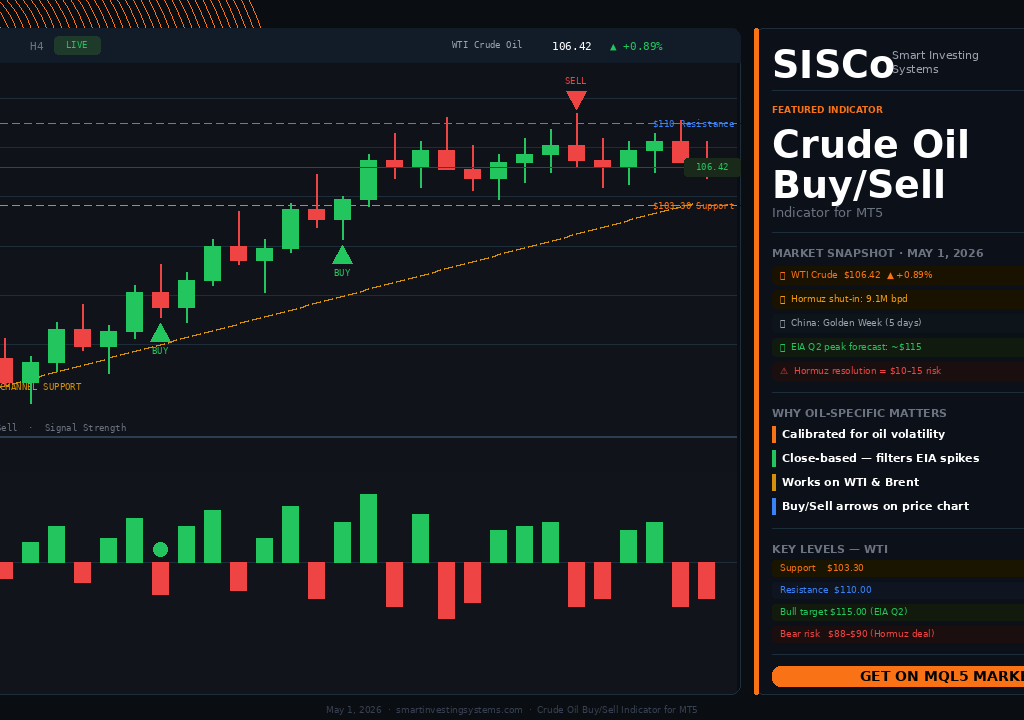
Crude oil trades differently from forex pairs. Its price is moved by a unique combination of geopolitical risk premium, inventory data, OPEC+ decisions, seasonal demand cycles, and refinery capacity constraints. Generic indicators calibrated for currency pairs frequently produce false signals on WTI and Brent because they do not account for these structural drivers. The result is that many traders apply the same RSI or MACD setup they use on EUR/USD to a commodity with fundamentally different volatility characteristics — and wonder why their signals keep misfiring.
The Crude Oil Buy/Sell Indicator for MT5 is purpose-built for this market. It is calibrated specifically for crude oil’s volatility profile, price structure, and session behaviour — delivering buy and sell signals that account for the way oil actually moves, not the way a generic momentum indicator assumes it does. On a day when WTI is at $106 and every major bank is revising its price forecast upward, this is exactly the kind of edge that separates oil traders from the rest of the market.
01Why Crude Oil Demands Its Own Dedicated Indicator
The price of crude oil is shaped by forces that do not affect forex pairs. Understanding these forces is the prerequisite to trading oil profitably — and it explains why the Crude Oil Buy/Sell Indicator is built the way it is.
Geopolitical Risk Premium
Oil prices carry a built-in geopolitical premium that spikes during supply disruptions. The current Hormuz closure has added an estimated $15–20 premium per barrel. This makes oil more sensitive to news flow than almost any other tradeable asset — and requires signal logic that accounts for volatility expansion during geopolitical events.
Inventory-Driven Volatility
The EIA Weekly Petroleum Status Report (every Wednesday) and the API report (every Tuesday) are the two most consistent volatility triggers in crude oil. A surprise inventory draw of even 2–3 million barrels can move WTI by $2–4 in minutes. Oil-specific indicators must be robust to these scheduled, high-amplitude events.
Session and Seasonal Patterns
Crude oil has distinct intraday patterns tied to the US open (09:30 ET), the EIA window, and end-of-day position squaring. It also has seasonal demand patterns — summer driving season, winter heating demand — that influence multi-week trend behaviour. A purpose-built indicator accounts for these cycles; a generic one does not.
02Reading the Hormuz Market — What the Charts Are Showing
The Hormuz closure, now in its third month, has created the most sustained directional crude oil trend since 2022. Understanding the current market structure is essential context for applying the indicator effectively right now.
Primary Trend — Bullish
WTI has been in a sustained uptrend since the Hormuz blockade began in late February. The indicator’s primary trend signal has been bullish throughout, with pullbacks to the $100–$103 support zone representing the key re-entry opportunities on the long side.
Current Zone — Consolidation
At $106, WTI is consolidating below the $110 resistance zone that represents the next major supply area. Today’s session is characterised by reduced volatility as China begins its five-day Golden Week holiday, removing a significant demand participant from the market temporarily.
Key Risk — Hormuz Resolution
Trump has signalled the Iran war is effectively won and is pushing for guarantees on nuclear non-proliferation. Any credible Hormuz reopening signal could trigger a $10–15 rapid correction. The indicator’s sell signal logic is designed to catch these sharp reversals when sentiment shifts.
Goldman Sachs currently forecasts Brent averaging above $100 for the full year, while the EIA projects a Q2 peak near $115. The bull case relies on the Hormuz disruption persisting through Q2. The bear case — a diplomatic breakthrough — could unwind the risk premium rapidly. Both scenarios are tradeable. The Crude Oil Buy/Sell Indicator is built to signal in both directions.
03Buy and Sell Signal Logic — How the Indicator Reads Crude
The indicator combines trend identification, momentum confirmation, and volatility filtering into a single signal output. Rather than displaying a complex multi-panel setup, it delivers clear buy and sell arrows directly on the price chart — with the underlying logic doing the heavy lifting invisibly.
- →Price above the medium-term trend baseline — oil in a bullish structure
- →Momentum shifts from negative to positive — buying pressure increasing
- →Volatility above the minimum threshold — market is active, not ranging
- →Signal fires on candle close — not intrabar, eliminating spike noise
- →Price below the medium-term trend baseline — bearish structure established
- →Momentum turns negative — selling pressure confirmed
- →Volatility confirms the move is genuine — not a thin market reversal
- →Candle-close confirmation — reduces false signals around news spikes
The candle-close confirmation is particularly important in crude oil. WTI is notorious for sharp intrabar spikes around EIA data releases, API reports, and geopolitical headlines. An indicator that signals on intrabar penetration will generate multiple false entries per week in this environment. Close-based logic eliminates the vast majority of these noise signals.
04Optimal Timeframes and Settings for Current Conditions
Crude oil’s behaviour varies significantly across timeframes. Here is how to configure the indicator for the current high-volatility, geopolitically-driven market environment.
| Timeframe | Best Use Case | Key Adjustment |
|---|---|---|
| M15 | Scalping around EIA/API data releases. High signal frequency, requires tight stop placement. | Reduce trend period; increase volatility minimum threshold to filter non-event noise |
| H1 | Intraday swing trades. Best balance of signal frequency and noise reduction for active traders. | Default settings work well; consider widening stops during Hormuz news windows |
| H4 | Multi-day trend following. Ideal for the current sustained uptrend from $88 to $106. | Extend trend baseline period to 20+ for cleaner primary trend reads |
| D1 | Macro positioning. Used to identify the primary $100–$115 range structure. | Use for direction bias only; execute entries on H1 or H4 signals aligned with D1 trend |
For the current Hormuz-driven market, the H4 timeframe is delivering the cleanest signals. The primary trend has been bullish since late February, and the H4 buy signals at the $103 support zone have been the highest-quality re-entry points in the current leg. With China’s Golden Week reducing volume today, the H1 will be noisier than usual — H4 entries are recommended through May 6 when Chinese markets reopen.
05A Practical Trading Framework for Crude Oil in May 2026
Establish your macro bias from the D1 chart
Before looking at any signal, check the daily chart. Is the indicator’s trend baseline above or below price? Is the most recent D1 signal a buy or a sell? In the current environment, the D1 has been bullish since February. This means you should be looking for H4 buy signals only — not shorting into a geopolitically-driven primary uptrend unless you see a confirmed D1 trend reversal.
Mark the key EIA and API report times for the week
The API report drops every Tuesday around 21:30 GMT. The EIA report drops every Wednesday around 14:30 GMT. These are the two most reliable crude oil volatility events of the week. Do not hold positions through these releases without a clear stop in place. The indicator will signal after the report candle closes — wait for that confirmation rather than anticipating direction.
Wait for the H4 buy signal at key support
The current primary support zone is $103.30. If WTI pulls back to this level, wait for the H4 candle to close and the indicator to fire a buy signal before entering. The indicator’s close-based logic will confirm that buyers have defended the level — rather than giving you a premature entry into a continuation of the selloff.
Size positions conservatively around geopolitical news windows
Any credible Hormuz reopening signal — a Trump-Iran diplomatic announcement, a naval agreement, or an IAEA inspection framework — could move WTI by $8–12 within a single session. This is tail risk, not normal market risk. Keep position sizes reduced relative to your normal crude oil trades until the geopolitical situation clarifies, regardless of what the indicator is showing.
Use the sell signal to manage longs — not only to short
In a primary bullish trend, sell signals are most usefully interpreted as exits from long positions rather than entries into shorts. When the indicator fires a sell signal on H4, consider reducing or closing your long position and waiting for the next buy signal to re-enter. Counter-trend shorts in a Hormuz-driven bull trend carry significantly elevated risk of sharp reversals.
06Mistakes That Cost Crude Oil Traders the Most
Trading crude oil with forex indicator settings. RSI periods, MACD lengths, and moving average periods calibrated for EUR/USD produce systematically delayed or early signals on WTI because crude oil’s average true range, session structure, and volatility clustering are fundamentally different. Always use oil-specific indicator calibration.
Ignoring the EIA inventory number as a trade invalidator. If you enter a long based on a buy signal and the EIA reports a surprise inventory build (more supply than expected), the fundamental thesis of the trade changes instantly. The indicator will eventually reflect this in a sell signal — but you should already have a plan for managing the trade through the EIA window before you enter.
Treating the Hormuz premium as permanent. The $15–20 geopolitical premium baked into current crude prices can unwind in hours if a credible diplomatic resolution emerges. Trading at $106 as if the current range is structurally supported — rather than risk-premium-supported — is the single most dangerous assumption in the current market.
Over-leveraging during Chinese market holidays. When China is on Golden Week (May 1–6 this year), crude oil liquidity thins considerably during Asian sessions. Thin markets amplify price swings and increase the probability of stop hunts. Reduce leverage during Asian session hours this week and focus on the European and US sessions for signal execution.
07The Bigger Picture — Why Oil Trading Skills Matter Right Now
Crude oil at $106 is not just a commodity price. It is the primary input into global inflation, the driver of energy-sector equity performance, the reason the BoE is facing a stagflation reckoning, and the variable that makes the ECB’s June decision genuinely uncertain. Every major currency pair is, to some degree, an oil trade right now.
The Canadian dollar (CAD) moves with oil — higher crude is structurally bullish for CAD. The Norwegian krone (NOK) tracks Brent closely. The Russian ruble’s reconstruction is entirely oil-dependent. And the US dollar’s strength partially reflects the US’s position as the world’s largest oil producer — benefiting from the same supply shock that is crushing European energy importers.
Understanding crude oil — and having a dedicated, calibrated tool to trade it — is therefore not a niche skill right now. It is central to understanding the macro environment that is driving every other asset you trade. The Crude Oil Buy/Sell Indicator gives you the dedicated signal layer that generic tools cannot.
Trade the $106 Crude Oil Market with a Dedicated Edge
The Crude Oil Buy/Sell Indicator for MT5 is purpose-calibrated for WTI and Brent — delivering clear, close-confirmed buy and sell arrows that account for oil’s unique volatility, session structure, and geopolitical sensitivity.
↗Conclusion
The Strait of Hormuz has been reshaping global markets for three months. WTI at $106, Goldman Sachs forecasting above $100 for the year, and the EIA projecting a Q2 peak near $115 — the crude oil trade is one of the clearest directional opportunities in markets right now. But it requires the right tool. Generic indicators calibrated for forex pairs will not give you the oil-specific signal quality you need to navigate this environment profitably.
Use the right tool for the right market. The Crude Oil Buy/Sell Indicator is built for exactly this environment — and exactly this moment in the commodity cycle.